

How to Choose a Temperature Humidity Test Chamber by Accuracy Requirements: 5 Key Metrics
Publish Time:2026-11-09Views:()
Test Standard: IEC 60068-2-78 — Test Cab: Damp Heat, Steady State
Put two temperature humidity test chamber datasheets side by side and they look almost identical: same temperature range, same humidity range, similar dimensions — yet the prices can differ by 30% or more. The difference almost never hides in the range. It hides in the accuracy metrics that most datasheets print in small type, if they print them at all.
For a quality lab, this is not a technicality. A chamber that barely holds its tolerance turns every test result into an argument: did the product fail, or did the chamber drift? This guide walks through the five accuracy metrics that separate a dependable chamber from an expensive box, using IEC 60068-2-78 as the reference point.
Why IEC 60068-2-78 Sets the Accuracy Bar
IEC 60068-2-78 (Test Cab: Damp Heat, Steady State) is the most widely cited steady-state humidity standard for electronic components. It requires the test sample to be held at 40°C / 93% RH within a tolerance of ±2°C and +2/−3% RH.
That window is what your chamber's accuracy has to live inside. If the chamber itself wanders ±1°C around the setpoint, more than half the tolerance band is consumed by the chamber before your product's behavior is even measured. Every accuracy metric below should be judged against this window.
Metric 1: Temperature Fluctuation — Stability Over Time
What it is: how far the chamber temperature wanders around the setpoint at a fixed measurement point over time. It answers: "I set 40°C — does it stay at 40°C?"
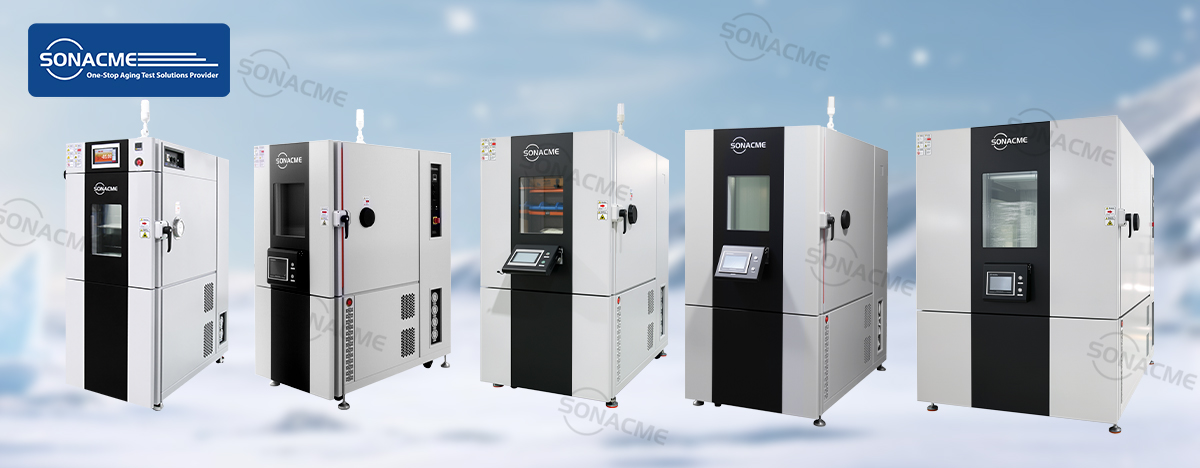
What to look for: ±0.5°C is workable; ±0.3°C is the class you want for standards work. SONACME's ST series holds ±0.3°C fluctuation across its full 64 L to 1000 L range.
Why it matters: with a ±2°C standard tolerance, a chamber that fluctuates ±1.0°C leaves almost no combined margin once spatial deviation (Metric 2) is added. A ±0.3°C chamber keeps the full tolerance band available for the test itself.
Ask the vendor: "What is the temperature fluctuation, and was it measured to IEC 60068 or GB/T 5170 methodology?"
Metric 2: Temperature Uniformity — Spread Across the Workspace
What it is: the difference between the highest and lowest temperatures measured at multiple points inside the working zone at the same time. Fluctuation is about time; uniformity is about space.
What to look for: 1.5°C or better. Uniformity depends on airflow design — duct geometry, air velocity, and how the refrigeration and heating stages are balanced. It is also the metric that degrades fastest as chambers get bigger, which is why a 1000 L chamber is much harder to build than a 64 L one. SONACME holds 1.5°C uniformity across the entire ST series, from 64 L to 1000 L.
Why it matters: your DUT is not at the geometric center. It sits on a shelf, near the wall, next to another sample. If the working zone varies by 3°C, two identical samples in the same run can see genuinely different conditions.
Ask the vendor: "What is the uniformity, measured at how many points, and does it hold in the largest model?"
Metric 3: Temperature Deviation — True Value vs Setpoint
What it is: the systematic difference between the displayed setpoint and the actual temperature at the sensor or workspace center. Fluctuation and uniformity describe stability and spread; deviation describes whether the whole cloud of readings is centered where you think it is.
What to look for: deviation within the standard's tolerance (±2°C for IEC 60068-2-78), plus the ability to correct it. Deviation is largely a systematic offset, so it can be trimmed by calibration — which is exactly why it is the metric most often abused. SONACME chambers use a controller developed in-house, which makes calibration offsets and profile corrections straightforward to apply.
Why it matters: an uncorrected deviation shifts every result in the same direction. If your chamber runs 1.5°C cold, your 85°C burn-in is really an 83.5°C test — and your customer's audit will eventually find out.
Ask the vendor: "Do you provide a multi-point calibration certificate, and what is the stated deviation?"
Metric 4: Humidity Control Accuracy — The Hardest Number
What it is: how tightly relative humidity is held. SONACME's ST series specifies ±2.5% RH humidity fluctuation.
What to look for: compare it directly against the standard's window. IEC 60068-2-78 allows only +2/−3% RH around 93% RH — a ±2.5% RH fluctuation already consumes most of that band, so anything looser is not credible for steady-state damp heat work.
Why it matters — and why humidity is unforgiving: relative humidity is temperature-dependent. Around 40°C, a 1°C temperature error shifts the apparent RH by roughly 5% — more than the entire tolerance of the standard. This is why humidity accuracy is built on top of temperature accuracy (Metrics 1–3): you cannot buy good humidity control in a chamber with mediocre temperature control. It is also why condensation-type tests (IEC 60068-2-30 / GB/T 2423.4 alternating damp heat, IEC 60068-2-38 composite cycling) are the toughest application: they push the chamber toward 95%+ RH with steep ramps, where control margins are thinnest.
Ask the vendor: "What is the humidity fluctuation, and what is the source of the RH measurement?"
Metric 5: Accuracy Under Load — Where Real Tests Live
What it is: all of the above, measured with your product inside. Datasheet accuracy is almost always verified on an empty chamber. A powered DUT adds heat; a dense load blocks airflow; a heavy sample changes how fast the chamber can respond.
What to look for: load capacity and ramp performance. The ST series carries 30 kg to 100 kg of test load depending on model, with heating and cooling rates of 3.0°C/min and 2.0°C/min — enough headroom for loaded chambers to track standard profiles such as the 12 + 12 hour damp heat cycle of IEC 60068-2-30.
Why it matters: a chamber that meets ±0.3°C empty can drift well outside its spec with a full load of powered samples. If your tests run loaded — and they do — the empty-chamber number is only the starting point of the conversation.
Ask the vendor: "Can you verify fluctuation and uniformity with a representative load, including powered samples?"
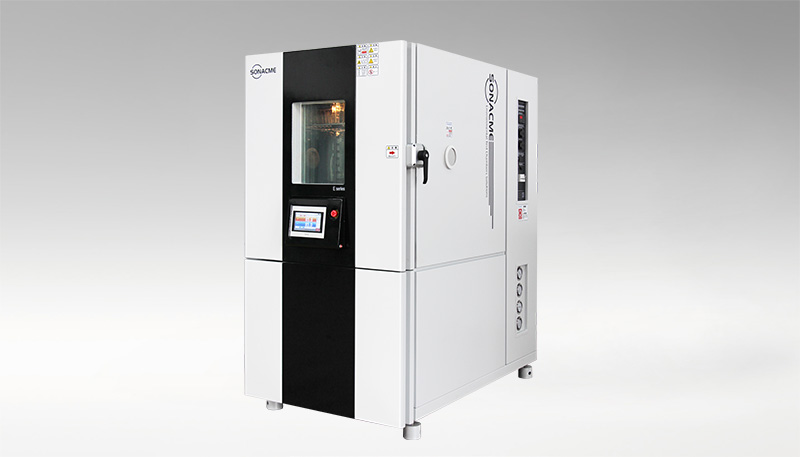
The SONACME ST Series: Accuracy Specifications
Model | ST/64/70(H) | ST/180/70(H) | ST/340/70(H) | ST/600/70(H) | ST/1000/70(H) |
Capacity | 64 L | 180 L | 340 L | 600 L | 1000 L |
Internal dimensions (mm) | 400×400×400 | 580×750×450 | 750×750×600 | 800×950×800 | 1000×1000×1000 |
Shared performance across the series:
· Temperature range: −70°C to +100°C (extendable to +150°C / +180°C)
· Humidity range: 10% to 98% RH
· Temperature fluctuation: ±0.3°C
· Humidity fluctuation: ±2.5% RH
· Temperature uniformity: 1.5°C
· Heating / cooling rate: 3.0°C / min and 2.0°C / min
· Test area load capacity: 30 kg to 100 kg by model
Supporting hardware backs the numbers: a 1.2 mm SUS304 stainless-steel working zone with full-welded seams, 100 mm polyurethane insulation, double silicone door seals, and a 4-layer heated observation window that stays frost-free at low temperature. The refrigeration system runs on Tecumseh, Bitzer or GEA BOCK compressors with DANFOSS and SAGINOMIYA valves, Schneider-class electrical components, and SONACME's own controller — with LOW GWP technology and R-449A refrigerant delivering up to 40% energy savings over long, accuracy-critical campaigns.
The Takeaway: Buy the Margin, Not the Range
Temperature range is a checkbox; accuracy margin is what your test report is built on. Before you compare prices, put the five metrics in a table — fluctuation, uniformity, deviation, humidity control, load performance — and check each one against the tolerance window of the standard you actually test to, starting with IEC 60068-2-78's ±2°C and +2/−3% RH.
Contact SONACME Technology with your accuracy requirements and test load, and we will recommend the ST series model — and verify its performance against your actual conditions. See the full [temperature humidity test chamber lineup](https://www.sonacme.com/products/index-42.html).
Latest News
-
JESD22-A104: Rapid Temperat...
A buyer's guide to temperature humidity test chamber...
-
JESD22-A104 Temperature Cyc...
A buyer's guide to temperature humidity test chamber...
-

IEC 60068-2-14 Nb: Rapid Te...
A buyer's guide to temperature humidity test chamber...
-

MIL-STD-810 Method 503 Ther...
A buyer's guide to temperature humidity test chamber...
-
IEC 60068-2-14 Na/Nb Testin...
A buyer's guide to temperature humidity test chamber...
-
JEDEC JESD22-A106 Complianc...
A buyer's guide to temperature humidity test chamber...
+86-180 2704 9206
Tel:+86(0769)83234966
E-Mail:info@sonacme.com
Contacts:Marcia/+86-180 2704 9206
Add:Building 7, No.310 Songbai Road, Liaobu Town, Dongguan City, Guangdong




 +86-180 2704 9206
 WhatsApp:+86-180 2704 9206
 info@sonacme.com
